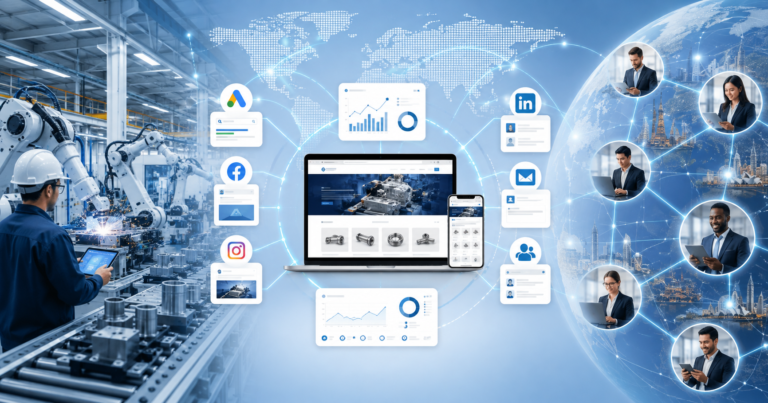




Expanding into international markets is no longer just an opportunity for large corporations. With the right digital marketing strategy, manufacturers, B2B companies, service providers, and DTC brands can reach customers across borders faster and more efficiently than ever before.
Digital marketing for global business refers to using online channels to attract, engage, and convert customers in international markets.
These channels typically include:
The key difference between domestic and international digital marketing is localization.
A strategy that performs well in one country may not work in another because customer behavior, purchasing habits, search terms, language, trust signals, and advertising costs can vary significantly.
For this reason, global brands need to think beyond translation. They need to adapt their entire digital marketing funnel to the expectations of each target market.
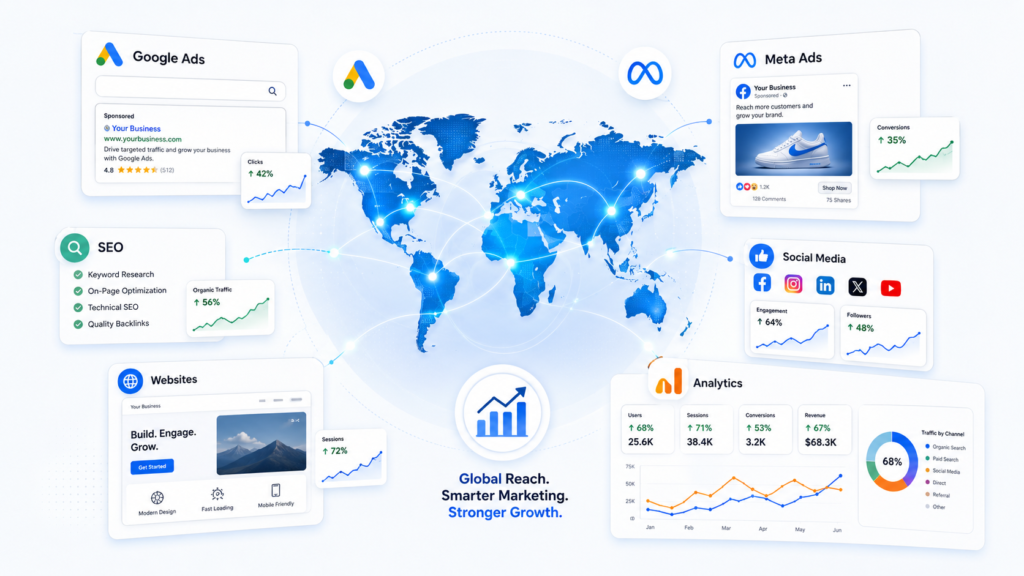
Traditional international expansion often requires distributors, local offices, trade shows, and large upfront investments.
Digital marketing lowers the barrier to entering new markets.
A business can test demand in the United States, Europe, Southeast Asia, or the Middle East without building a physical presence first.
More importantly, digital marketing gives businesses measurable data.
You can see:
This makes global expansion more data-driven and less dependent on assumptions.
For companies planning international expansion, Google’s guidance on entering overseas markets also emphasizes identifying market opportunities, adapting campaigns locally, and optimizing advertising by region.
A strong international digital marketing strategy should not depend on one single traffic source.
The most successful companies usually combine several channels.
SEO helps your website appear in search engines when potential customers actively look for products, suppliers, services, or solutions.
For B2B companies, this could include keywords such as:
For DTC brands, SEO may focus more on product-related searches, buying guides, comparisons, and informational content.
Unlike paid advertising, SEO can continue generating traffic even after the initial content investment.
This makes SEO especially valuable for long-term international growth.
At HaoLink, our Content Marketing & SEO Strategy focuses on search intent, on-page optimization, authority building, and measurable global growth.
HaoLink currently positions its services around full-cycle digital growth, including SEO, website optimization, Meta advertising, localized content, and attribution.
Google Ads allows businesses to reach customers who are already searching for a product or solution.
This makes Google particularly effective for:
For example, someone searching for:
“industrial valve manufacturer USA”
has much stronger commercial intent than someone casually browsing social media.
For global campaigns, companies should create separate campaigns for important regions rather than placing every country into one campaign.
This allows better control over:
Meta Ads are especially powerful for DTC brands and products that can be visually demonstrated.
Facebook and Instagram allow brands to reach potential buyers based on interests, behavior, engagement, and historical conversion data.
Meta works particularly well for:
For B2B and service businesses, Meta can also generate leads when paired with strong creative, clear positioning, and optimized landing pages.
The important point is that modern Meta advertising is increasingly dependent on creative quality and conversion data rather than simply selecting narrow interests.
Social media should not only be viewed as an advertising channel.
It is also a trust-building channel.
Before purchasing from an unfamiliar overseas company, many customers will check:
A completely empty social media profile can reduce trust.
For global businesses, content should therefore support the entire buyer journey.
Useful content may include:
Content marketing helps businesses demonstrate expertise before a customer contacts them.
This is especially important for industries with long sales cycles.
For example, an industrial manufacturer may publish:
A service company may publish:
High-quality content allows potential customers to understand your expertise before speaking with your sales team.
This reduces trust barriers and can improve lead quality.
Getting traffic is only the first step.
Many international buyers will not purchase or submit a large order immediately.
They may need several interactions before converting.
A CRM system allows companies to track leads and continue communicating with prospects.
Typical follow-up sequences may include:
For B2B companies, this process is especially important because the decision cycle may last several weeks or even months.
Without proper lead management, a company may generate traffic but lose potential customers later in the funnel.
One of the most underestimated parts of digital marketing is tracking.
Advertising platforms need accurate conversion data to understand which users are most likely to become customers.
Businesses should normally track events such as:
Meta’s Conversions API is designed to create a more direct connection between a company’s marketing data and Meta, helping businesses improve measurement and campaign optimization.
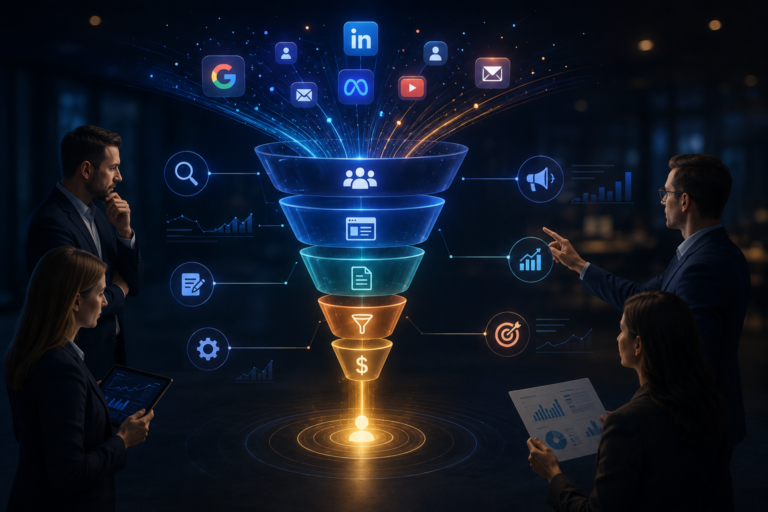
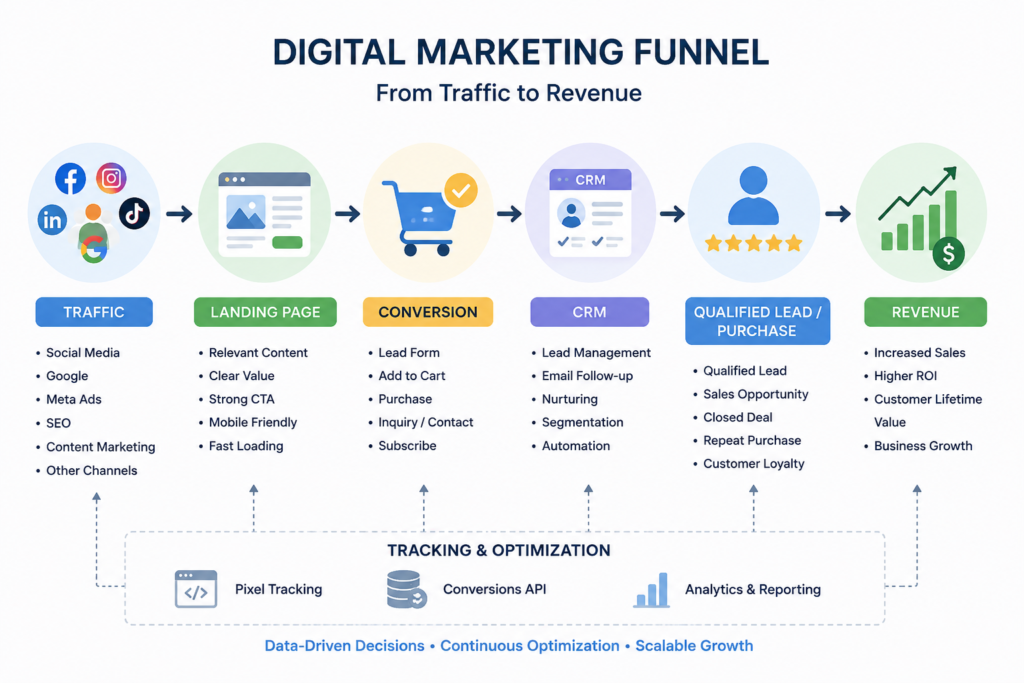
A strong global digital marketing strategy should follow a clear funnel.
Traffic can come from:
At this stage, the goal is to reach the right audience.
Your website must clearly explain:
For international markets, your website should also be optimized for:
A strong advertising campaign cannot compensate for a weak landing page.
Depending on the business model, the conversion may be:
For DTC:
Traffic → Product Page → Add to Cart → Checkout → Purchase
For B2B:
Traffic → Landing Page → Inquiry → Sales Follow-Up → Qualified Lead → Contract
This difference is important.
A B2B company should not evaluate campaign performance only by immediate purchases.
Lead quality and downstream sales matter much more.
Most users will not convert during their first visit.
Retargeting allows businesses to reconnect with people who:
Retargeting can significantly improve the efficiency of the entire marketing funnel.
The final goal is not clicks.
It is profitable growth.
Businesses should connect advertising data with real business outcomes.
Important metrics include:
Global digital marketing strategies should change depending on the business model.
B2B buyers usually care about:
The sales cycle is usually longer.
The main goal is often generating qualified leads rather than immediate purchases.
DTC customers usually care more about:
The purchasing decision is often faster.
DTC marketing therefore relies heavily on creative advertising, product pages, reviews, and offers.
HaoLink currently works across both industrial B2B lead generation and DTC e-commerce growth, combining website optimization, performance advertising, tracking, and localized content.
You can also explore HaoLink’s global growth case studies across industrial B2B, DTC, and service-based industries.
Many companies waste advertising budgets because they expand too quickly.
Here are some of the most common mistakes.
Different markets have different advertising costs and customer behavior.
Start with a small number of priority markets.
Test first, then scale.
Direct translation is rarely enough.
Good localization considers:
Advertising traffic should normally go to a dedicated product page or landing page.
The page should match the user’s original search or advertisement.
Slow websites can destroy advertising performance.
If users click an advertisement but leave before the page loads, the advertising budget is wasted.
This is especially important when targeting customers thousands of kilometers away.
Low-cost traffic is not always good traffic.
A campaign with a CPC of $0.30 but no purchases may be worse than a campaign with a CPC of $1.50 that generates profitable customers.
Always evaluate the full funnel.
Increasing budgets too aggressively can reduce campaign efficiency.
A more sustainable approach is:
Test → Validate → Optimize → Scale
This allows businesses to identify weaknesses before spending large amounts of money.
A practical global digital marketing plan can follow these six steps.
Evaluate:
Do not choose a country simply because it has a large population.
Identify:
Your website should communicate trust immediately.
For overseas customers, consider including:
Do not spend your full budget immediately.
Test different:
Let the data determine where to scale.
Make sure advertising platforms receive accurate data.
This helps both reporting and optimization.
Once a market, offer, and funnel have proven profitable, gradually increase:
The goal should be creating a repeatable acquisition system rather than relying on one viral advertisement.
Digital marketing is becoming increasingly automated.
Advertising platforms now use machine learning to optimize:
At the same time, privacy restrictions are making first-party data and server-side tracking more important.
Businesses that succeed globally will increasingly combine:
Strong Creative + Localized Content + First-Party Data + Accurate Tracking + Fast Websites
Technology can improve targeting and automation, but businesses still need strong positioning and a clear understanding of their customers.
Digital marketing gives companies an unprecedented opportunity to enter international markets.
However, successful overseas growth requires more than simply running advertisements.
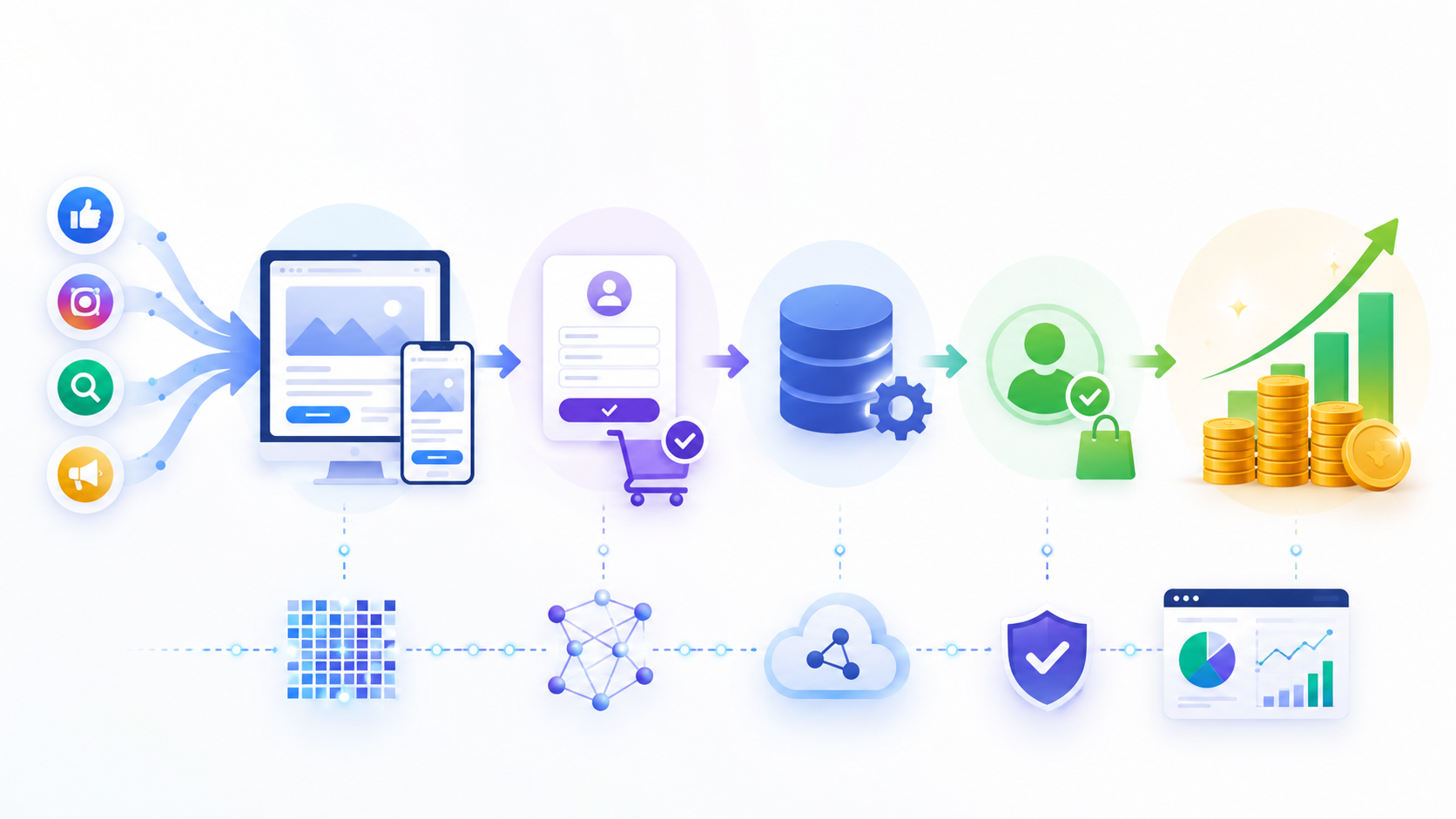
Companies need an integrated system that connects:
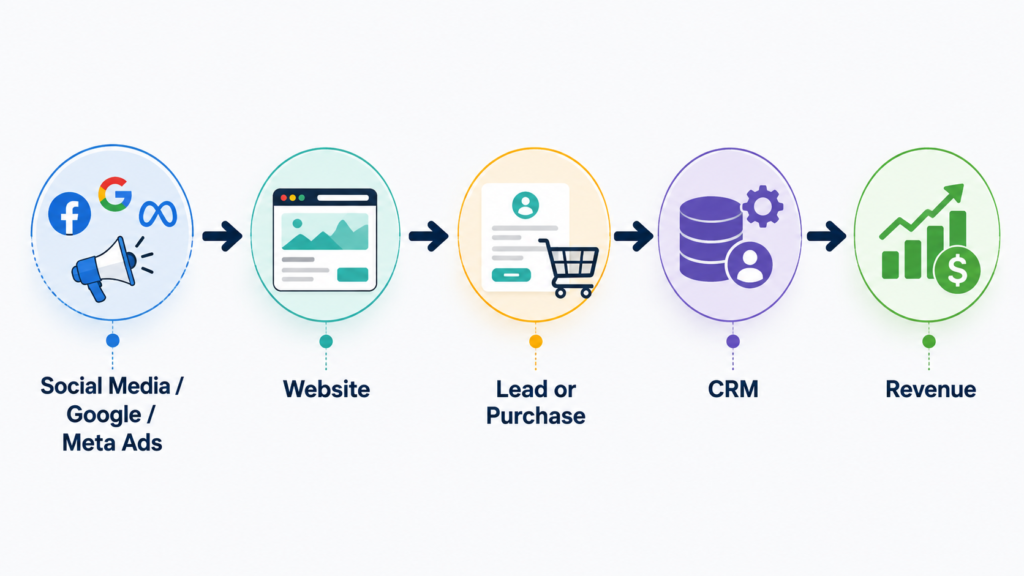
Traffic → Website → Conversion → Data → CRM → Revenue
The businesses that build this system early will have a major advantage when expanding globally.
Whether you are a manufacturer looking for international buyers, a service company generating overseas leads, or a DTC brand entering new consumer markets, digital marketing can become a scalable engine for long-term international growth.
At HaoLink, we focus on building full-cycle digital growth systems that connect advertising, websites, content, attribution, and conversion optimization to help businesses compete in international markets.