




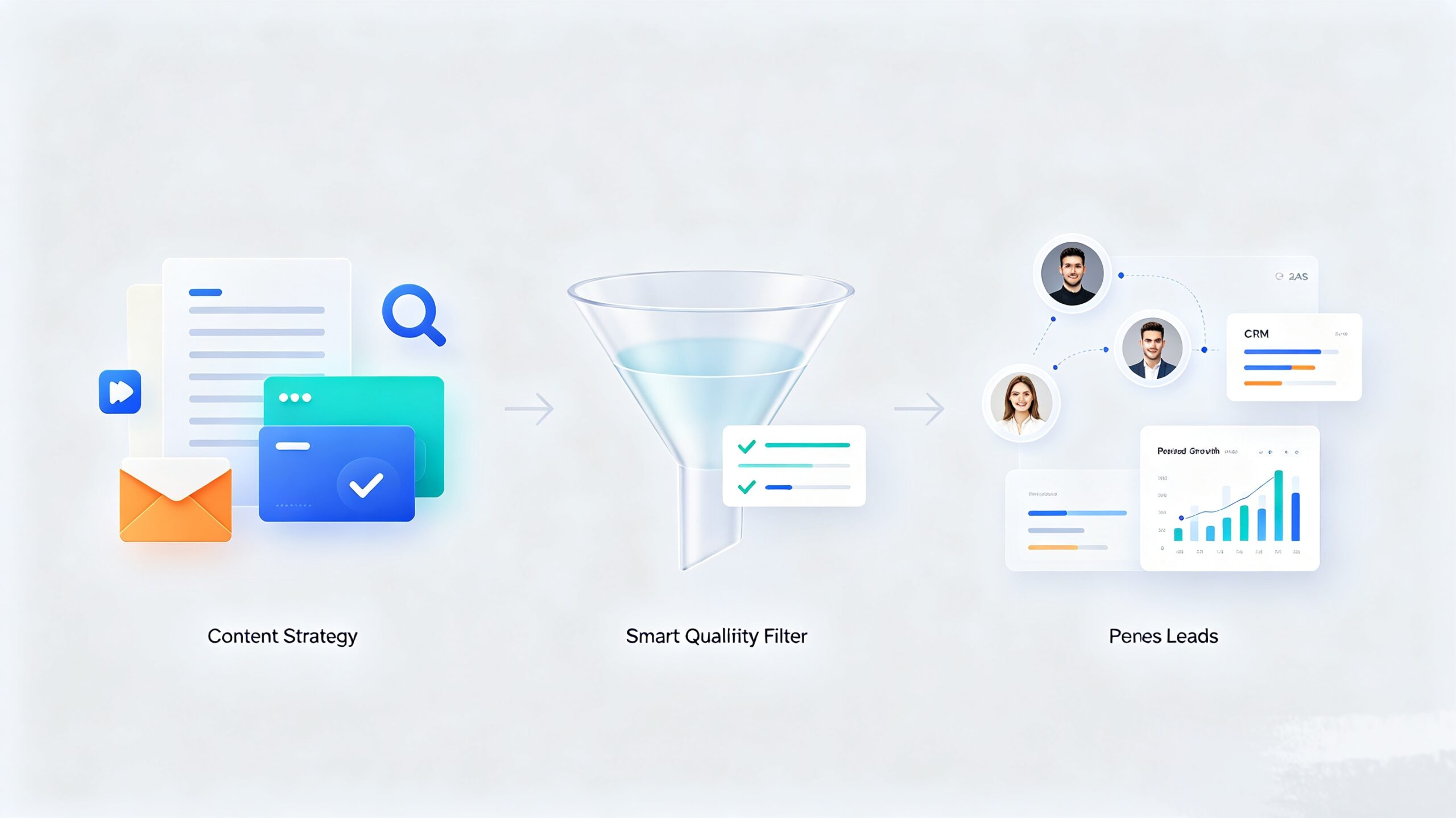
Publishing blog posts alone does not guarantee leads.
Many companies invest time and resources into content creation but struggle to connect their content with measurable business results. They may generate website traffic, social engagement, or impressions, yet receive very few qualified inquiries.
The problem is usually not a lack of content. It is the absence of a clear content marketing strategy.
An effective content marketing strategy connects audience needs, search behavior, business goals, and conversion paths. It helps companies attract the right visitors, build trust, and guide potential buyers toward taking meaningful action.
For B2B companies, manufacturers, service providers, and growing brands, content can become a reliable long-term lead generation channel when it is planned correctly.
A content marketing strategy is a structured plan for creating, publishing, distributing, and measuring content that supports specific business objectives.
It defines:
A strong strategy goes beyond deciding what to publish.
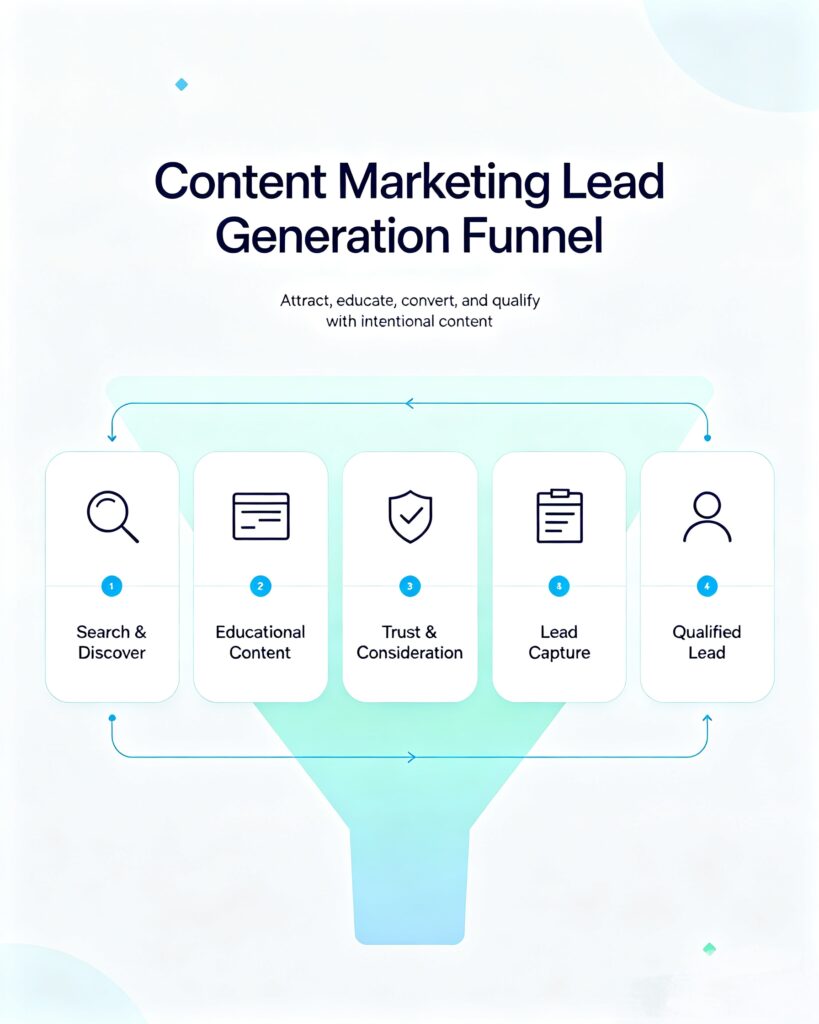
It connects every piece of content to a specific stage of the customer journey.
For example, an educational article may attract visitors who are researching a problem, while a case study may help decision-makers evaluate a potential service provider.
The goal is not simply to generate more traffic. The goal is to attract relevant prospects and move them closer to becoming qualified leads.
Modern buyers often research independently before contacting a company.
They may compare suppliers, search for solutions, read guides, review case studies, and evaluate a company’s expertise before submitting an inquiry.
Content helps businesses participate in this research process.
A well-executed content marketing strategy can help you:
Content also gives your sales team useful resources to share with prospects.
Instead of repeatedly explaining the same information, your company can send buyers a relevant guide, comparison article, FAQ, or case study.
A successful strategy starts with customer understanding, not content production.
Before writing articles, you need to know who you want to attract, what they care about, and what action you want them to take.
Your content should be created for a clearly defined audience.
Ask questions such as:
A B2B manufacturer may need to target procurement managers, distributors, contractors, or business owners.
A marketing agency may target founders, marketing managers, or export managers.
The more specific your audience definition is, the easier it becomes to create relevant content.
Effective content addresses real business problems.
Potential customers rarely search for a company first. They usually search for information related to a challenge.
For example:
These questions reveal what your audience cares about.
Your content should help readers understand the problem, evaluate possible solutions, and determine the next step.
Every content strategy should support measurable objectives.
Common goals include:
Avoid using traffic as the only measure of success.
An article that receives 500 highly relevant visits and generates five qualified leads may be more valuable than an article that receives 10,000 visits but generates no inquiries.
Keyword research helps you understand how potential customers search for information.
A strong keyword strategy should include several types of search intent.
These users are learning about a topic.
Examples:
These users are comparing options or exploring services.
Examples:
These users may be ready to contact or purchase.
Examples:
A healthy content strategy should target all three stages.
Do not choose keywords based only on search volume. Relevance and commercial intent are often more important.
Publishing unrelated articles makes it difficult to establish authority.
A better approach is to organize content into topic clusters.
A topic cluster contains:
For example:
Content Marketing Strategy
├── B2B Content Marketing
├── Content Marketing Funnel
├── SEO Content Writing
├── Content Marketing Examples
├── Content Distribution Strategy
├── Lead Generation Content
└── Content Marketing Metrics
This structure helps users explore related information and helps search engines understand your website’s expertise.
To see how content can support B2B growth, read our guide to Content Marketing for B2B Companies: Strategies, Best Practices & Lead Generation
Not every visitor is ready to contact your company immediately.
Your content should support different stages of the buying journey.
The user is identifying a problem.
Suitable content:
The user is evaluating solutions.
Suitable content:
The user is choosing a provider.
Suitable content:
A common mistake is publishing only awareness-stage content.
This may generate traffic, but it does not always create a clear path toward conversion.
High-quality content should be useful, specific, and actionable.
Strong B2B content often includes:
Avoid producing articles that only repeat generic information.
Whenever possible, include insights from real projects, customer questions, campaign experience, or industry knowledge.
This makes the content more credible and more difficult for competitors to copy.
Content should be written for people first, but it should also be structured for search engines.
Each article should include:
Avoid repeating the main keyword unnaturally.
Keyword stuffing can make the article difficult to read and does not improve quality.
For official guidance on creating helpful and search-friendly content, review the resources provided by Google Search Central
Content does not generate leads automatically.
Every article should provide a logical next step.
Possible calls to action include:
The CTA should match the reader’s stage of awareness.
For an introductory article, a downloadable guide may be more appropriate than an aggressive sales message.
For a case study or service comparison article, booking a consultation may be appropriate.
A lead magnet gives visitors a reason to share their contact information.
Examples include:
The lead magnet should solve a specific problem and relate directly to your service.
For example, Haolink could offer:
Free B2B Website Lead Generation Checklist
Visitors who download the checklist are more likely to be interested in website optimization, SEO, or lead generation services.
Publishing is only the first step.
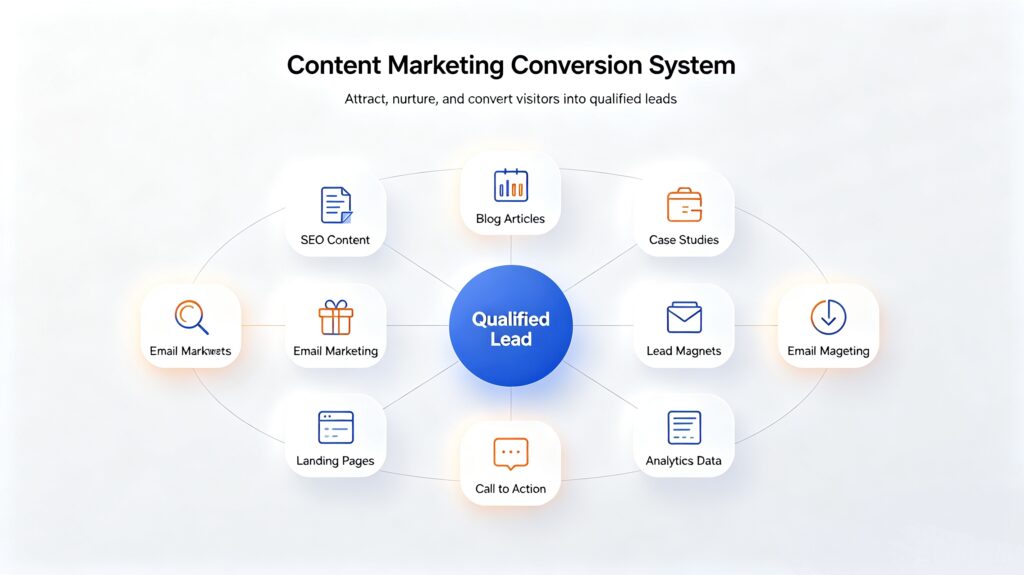
Content distribution helps your articles reach more potential customers.
Useful channels include:
Optimize articles so they can appear in search engine results.
Share insights, article summaries, industry opinions, and case study results.
Send useful content to subscribers, prospects, and existing customers.
Turn long-form articles into short posts, graphics, carousels, and videos.
Promote high-performing content to relevant audiences.
Use articles and case studies to answer common prospect questions.
One article can be repurposed into:
This improves content efficiency and gives every article more opportunities to generate leads.
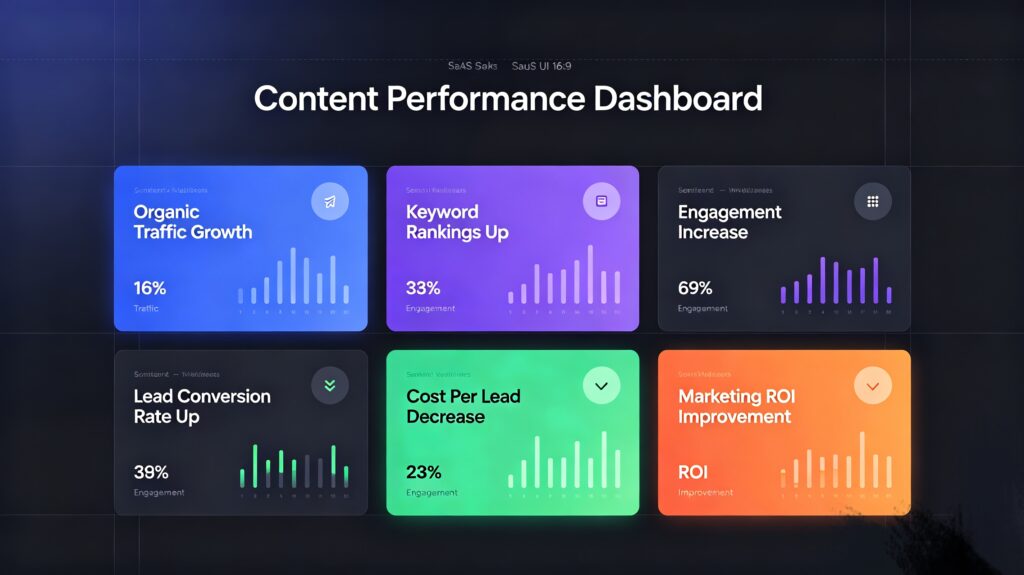
The right metrics depend on your business goals.
Useful content marketing metrics include:
Traffic metrics help you measure visibility, while conversion metrics show whether the content is contributing to business growth.
You should also track which articles assist conversions.
A visitor may first discover your business through an educational guide, return later through another article, and finally submit a form after reading a case study.
For additional frameworks, research, and benchmarks, explore the resources from the Content Marketing Institute
Many companies fail to generate leads because they make one or more of the following mistakes.
Random content rarely creates consistent business results.
High-volume keywords may attract visitors who are not potential customers.
Buyers want useful information, not constant sales messages.
An article should answer the question behind the keyword.
Internal linking helps users discover related content and strengthens website structure.
Visitors need a clear next step.
Outdated articles may lose rankings, trust, and relevance.
Traffic is valuable only when it supports meaningful business goals.
Content marketing attracts potential buyers, while conversion rate optimization helps turn them into leads.
A high-performing content page should include:
Even excellent content can underperform if the website is confusing or difficult to use.
This is why content strategy, website design, SEO, and CRO should work together.
Learn how website structure and conversion design support lead generation in our guide to building a High Converting Website
Before publishing content, confirm the following:
This checklist helps ensure that every article contributes to both SEO and lead generation.
A successful content marketing strategy is not based on publishing as much content as possible.
It is based on publishing the right content for the right audience at the right stage of the buying journey.
To generate qualified leads, businesses need to combine:
When these elements work together, content becomes more than a source of website traffic.
It becomes a long-term business asset that attracts potential customers, builds trust, supports sales, and generates qualified leads.